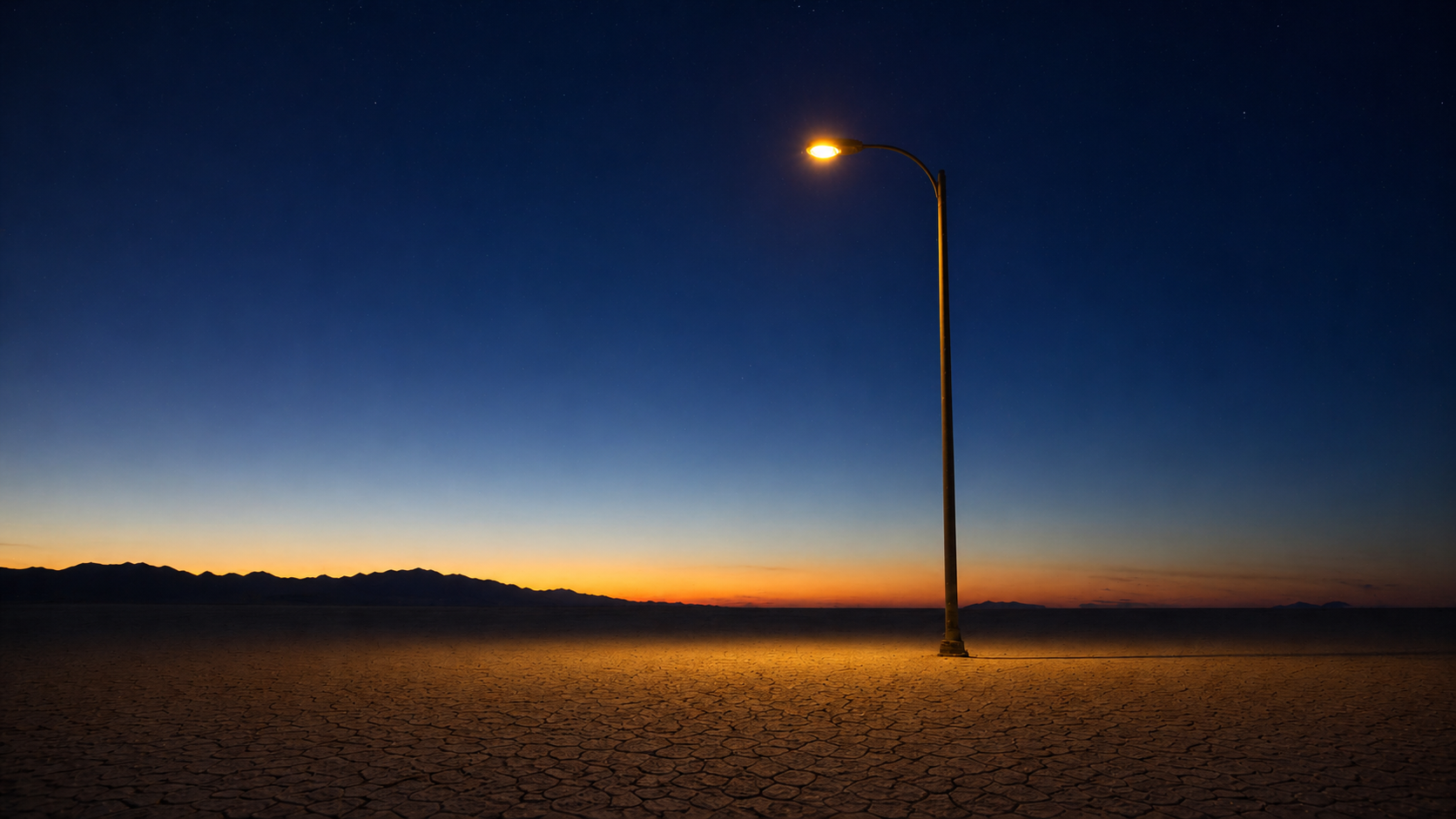
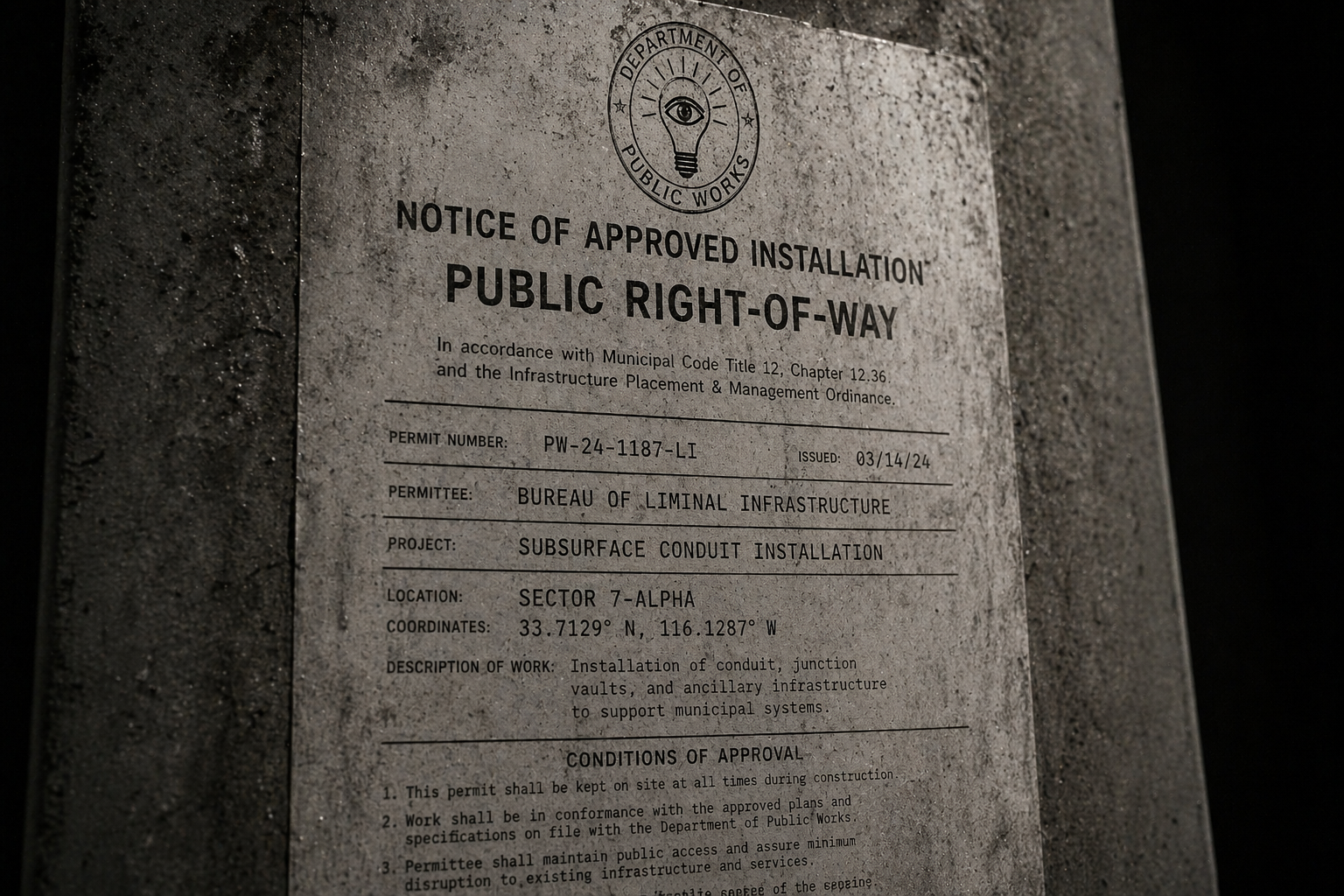
A liminal aperture is a location at which the boundary between consensus reality and adjacent dimensional strata has become measurably thin. Apertures occur naturally at sites of transitional geographic character — dry lakebeds, tidal margins, temporary settlements, places that are seasonally one thing and then another. The Bureau does not create apertures. It finds them, assesses their classification, and installs the appropriate stabilization infrastructure.
The Black Rock Station aperture has been classified Class 3: Active, Attended.
“attended” means something is already on the other side and has noticed the opening. first thing they teach you. — R.
Class 3 designations indicate that the aperture is not merely a thinning of the boundary but a location of active interest from entities in adjacent strata. The nature of these entities is not within the Bureau’s research mandate. Field crews are trained to manage the interface, not to characterize what lies beyond it. What documentation exists has been assembled over generations from field observation, annotated maintenance logs, and the accumulated judgment of senior technicians.
“accumulated judgment” is a polite way of saying we learned what not to do by watching what happened to people who did it. — R.
What is known, operationally: the entities that attend Class 3 apertures are not recent arrivals. Cross-referencing of Bureau installation records with independent historical documentation suggests continuous activity at several monitored sites predating the Bureau’s own founding records. At the oldest monitored sites, there are no founding records. There is only the infrastructure, and the inference that someone put it there.
The entities interact with the aperture surface rather than through it. The stabilization apparatus functions as a one-way interface: they can observe, and in some documented cases, modulate what is visible or perceptible from the near side. They cannot cross. This is the Bureau’s primary operational guarantee and the reason the infrastructure must remain active and maintained at all times.
“cannot cross” is accurate as long as the hardware is up. seen what happens during an unplanned outage. don’t let the hardware go down. — R.
Visitors within the stabilized zone may experience the following, all of which fall within documented parameters: a sensation of being observed from above or from within the light source itself. A sudden acute awareness of the boundary between the illuminated radius and the surrounding dark. Brief perceptual events in which the projected field appears to respond to attention rather than movement — as though the system has registered something the sensors have not. A feeling, reported consistently and across demographics, that the light overhead is not indifferent.
The Bureau does not characterize these experiences further in public documentation.
Field Supplement 7-G, Section 4: Documented Interaction Typology, Classes I through IV. Available to credentialed field personnel only.
What can be said: the entities that attend this aperture are old. The Bureau’s operational taxonomy does not assign them names. Names imply a level of mutual comprehension the Bureau does not claim. What they are called among long-serving field crews is not standardized and is not repeated here.
They are curious. They are patient in a way that has no meaningful human analog. Some of them appear to find the creatures that gather beneath the lamp interesting — in the way that the deep ocean finds things interesting that drift near a light source at pressure it was not built for.
The infrastructure holds.
so far. — R.